
Worn Story
A couple of shirts and my grandfather.

I’ll warn you - this one is long. I admit I wrote it long not to impress you with my wordiness or knack for storytelling - I wrote it long for myself. I’ve never been able to write this story or tell it to anyone, so please forgive the extra details as I relive it through them. It’s also not exactly about me or things that are mine. It’s about my grandfather and what he left behind.
I’ve not yet read Emily Spivack’s Worn Stories (2014), but I feel a sincere missed opportunity by it not being on my bookshelf. If you’ve not heard of it, Spivack compiles the stories told by others about an item -or items - of clothing that hold a deep meaning in their lives. A synopsis I read says that her purpose in doing so is to explore how clothes can hold our memories, how they are outward expressions of our cultures, and in many ways shape and reflect our identities. A Netflix limited series adaptation was released in 2021, which I highly recommend.
I was quite taken by the stories told in the show, and loved how similar the narratives were to the experiences we each have with food - the great equalizer, uniter, and thing we all have most in common. I was also quite struck by the realization that I, too, had a worn story of my own. I’ve become too far removed from the cultures I was born into for clothing to have a deep representation of belonging, but I do have items that tell part of the story of my life. Two of them are my grandfather’s shirts.
Together with his Shriners ring, they’re all I have left of him.
My grandfather - Papa, as I called him - was born on a farm in Woodrow, Texas in 1924 - just shy of a century before my son would be born. His family was already poor when The Great Depression began in 1929, so he grew up, quite literally, with nothing but the shirt on his back - and occasionally shoes that actually fit. He was also the middle boy, which meant that he was expendable - his eldest brother was the heir to the farm and therefore needed to be preserved, while his youngest was often too small for certain duties. This meant that the most dangerous tasks were reserved for my Papa. At the age of 8, he was sent by his father to hold down the rotor at the top of a windmill during a tornado in the middle of the night. It wasn’t the first time, and wouldn’t be the last.
Not long before he died, he admitted to me that when the wind blew hard at night, he would have flashbacks of securing the windmill, reliving the nightmare in his sleep. Sometimes, when no one had gone to the store in while, he’d find himself back in his childhood home, being forced by his father to fight with his brothers under the table for extra morsels or scraps.
In his teens, my Papa was a high school baseball and football star, even though he wasn’t allowed by his parents to play sports. He was expected to come home after school and work. To hide it, he would take cold showers after games and practice so he didn’t come home sweaty. The shock of the cold water on his warm skin caused nerve damage on his face, leaving his right eye in permanent squint. Despite this, he looked to have a bright future, and possibly a scholarship to college.
But all of this was not to be. Being expendable, he was the one offered up to the draft to fight in World War II. He served on the USS Libra in the South Pacific, seeing parts of the world he never dreamed could have existed - but at the cost of manning an anti-aircraft gun in some of the Pacific’s most heated battles. He survived a battle where he shot down a plane that would crash into the ship, which was then struck by another performing kamikaze. He saw parts of the world that I may never see, but what he saw was enough. The beauty of Fiji, Samoa, Tonga, Solomon Islands, and Pitcairn, weren’t enough to outweigh the fierceness of war, or the safety of home.
He once told me, in a rare moment of vulnerability, that even in his old age, if it wasn’t the memory of the windmill that came for him in the dark, it was the memories of gunfire. He remembered seeing the bullet streaks racing across the sky, mixing until he didn’t know who was shooting at who - until he saw only men fighting men whose true purpose was peace. He was always a quiet man, but I had never seen him go so quiet - or open up so much about anything.
From the harshness of his life, my Papa grew to be a grumpy, quiet man. He was introspective, quietly well-read, and kept most of his thoughts to himself. He didn’t like loud noises, loud places, or too much excitement. But he loved look out the window, visit with neighbors who passed by on a walk, and the joy of children and to pretend-play - at least for a time.
Before my sister and I were born, my brother Jacob was the light of Papa’s life. Jacob looked like my mom, who looks like Papa, and together, with their dark hair and brown eyes, they were the perfect succession of alike generations. When Jacob was three, he found a way to get to the pool in the backyard when no one was looking, and drowned. To say Papa was heartbroken is the greatest understatement of all time. My mom once said that after Jacob died, Papa was never the quite same - he never allowed himself to love the same as he did before, as a way to guard his heart. And so that layer of grumpiness got a little thicker - especially when it came to unruly children.
As you might guess, I was that unruly child. I was spoilt and screamed a lot, I was loud in voice and in my lack of self control. I occasionally broke things in my impulsiveness, like the ceiling light in his car that he was too cheap to fix - something about him my mom and I continue to laugh at to this day. He loved me as a baby - called me Big John, and sang lullabies to me. But when I became a feisty boy, he and I ceased to mix. For many years I was afraid of him and would do my best to simply stay out of his way. It likely didn’t help that I reminded Papa of my dad, who called him by his first name when they met - which Papa didn’t like - or that fact that my dad can be brash and overconfident. Us living overseas and only visiting during winter and summer breaks certainly only increased our distance.
What does this have to do with shirts? We’re about to get there.
While I was in college and in my early 20’s, I began to be overtaken by the inevitable change that unexpectedly comes for all of us one day. I was still extraverted, but less and less. I began to become more introspective and more interested in listening than speaking. Shooting the piss over beers became more my thing than parties, until quiet walks and gardening took over that. More and more, I began to see myself in my Papa than I did the man I used to be afraid of. I began to call him more often, even though he could barely hear. We began to share a bond beyond that we didn’t have before, a friendship that was more than the jalapeno eating contests that he always won. We’d tell each other stories and terrible jokes. We slowly became the grandfather and grandson that, I think, we both needed. But like all good things, it would eventually come to an end.
When I was 22, Papa was diagnosed with terminal cancer. It was his second time, and there wasn’t enough of his lung to safely remove any of it. He was 88, but decided to fight it anyways, even if the battle was going to be short. The cancer spread quickly, and so it was very short.
I don’t remember when I was told that he had cancer, but I remember going to Lubbock right after to spend the weekend with him. By the time I got there, the treatment had taken his voice, and could only make painful creaks and whispers.
When I arrived, he was sitting in a white plastic lawn chair in the backyard he had once tended so well for so long, wearing a ragged red flannel and Texas Tech baseball cap - both likely from the 1990’s - watching his chickens preen the grass. I pulled a chair next to his and sat there in silence with him as we both held the weight of the moment. We couldn’t look at each other until he finally took my hand in his.
I’ll never forget the face he made trying to whisper something to me - it looked like he had swallowed fire. He eeked out something inaudible, choked, and then quit, looking more sad and defeated than before. We looked at each other until I was finally able to break the silence. It couldn’t have been this eloquent, and has likely been massaged by many years of echoing in my mind, but I know I said something to this effect:
“We don’t have to speak for me to know that you love me. I love you too.”
And then we cried together, inconsolably in the backyard. As I write this, I am crying - doing my best to disassociate from my feelings so that I can keep writing.
The following day seemed to be a better day for Papa. My sister and our cousins were on the way, so perhaps the medicine of family was working on him. I remember that he had dressed himself that day because I went in to help and he was buttoning his shirt - yet another ancient get-up from decades ago. I remember that he was able to eat what was considered a full breakfast for someone in his state - a bowl of oatmeal without fruit or sweetening - and it gave him enough strength - mixed with painkillers - to kind of, sort of whisper-speak. It’s amazing how different the day-to-day experience can be for someone who is fighting cancer.
While we waited for everyone to arrive, Papa had my mom and grandma dig out keepsakes he’d squirrelled away. He was excited that people were there, wanted to do a little show-and-tell for things we had only talked about before. He showed me the picture of the USS Libra and the crew he served with when they departed from California. He pointed out the ones who came home and the ones who didn’t. He told me about getting into a brawl with someone in a public toilet in Auckland because his buddy liked to fight, and how in Fiji they traded bags of sugar for chickens - they almost had to give the chickens back because they accidentally gave them salt, and the locals were quite angry. I remember asking him if there’s anything he would have done differently. He said he would have never left the farm.
He spent the day whispering away in his chair until fatigue finally set in. When my sister arrived he couldn’t speak anymore, and it seemed I had gotten the very last of his voice.
I had to fly back that night, and for the first time I felt that a trip to Lubbock was all too short - normally I was dying to get away, but this time I felt grounded in place. I remember when I said goodbye, Papa couldn’t say anything. We hugged for a long time, his frail body against mine, and I promised I would come back to see him again. It was the first time as an adult I told him a lie - even if I didn’t mean to.
I can still see him standing there as I said the words, balancing himself with one hand on his old chair, JC Penny-brand blue shirt and black pants from ages and ages ago, his eyes thin and weak through his wide frame glasses, putting on a brave face. He probably knew that this was it, but didn’t want to tell me so.
My Papa, Dayton Goode, died on April 11th, 2012, succumbing to his cancer. He went peacefully, as he did most things, gently and quietly in his own way.
I remember being prepared for the phone call, and remember taking it quite well - I’ve always been good at suppressing my feelings. But what I was not prepared for was the disaster that would follow. My flight to Lubbock got cancelled two days before the funeral. I don’t remember the reason, but I remember shouting quite a bit. I remember the airline trying to get me a flight for the following week, but had to turn it down because this was happening during my college finals. I missed the funeral. The presiding pastor was kind enough to put a cell phone in his shirt pocket so I could listen to the service. I remember listening, a thousand miles away, weeping in my bedroom. My mom said that she and others wore yellow - Papa’s favorite color. I put on the only yellow shirt I had that day - some yellow away strip for Wales’ national rugby team that they wore one time, in a year I don’t remember.
My grandma continued to live in her and Papa’s house until her dementia was too advanced for her to take care of herself. While she was still there, she wouldn’t clean any of Papa’s things out. For two year, the house stood as a museum to their life together.
In September 2014, my grandma had to move into an assisted living facility, and my mom finally had to clean out the house to prepare to sell it. I drove the long way from Pittsburgh, PA to Texas to help. I had dropped out of law school in January and was in the start of what would be a two-year transitional period. My mom had helped Papa die mostly by herself - I didn’t have anywhere to be and certainly wasn’t going to let her do this alone if I could help it.
When I arrived, my mom was cleaning out Papa’s clothes. Most of them were in bags for donation, except for a few things that were not so threadbare that they threatened to fall apart of you breathed on them. My mom handed me two folded shirts, telling me to try them on, saying that they might fit me.
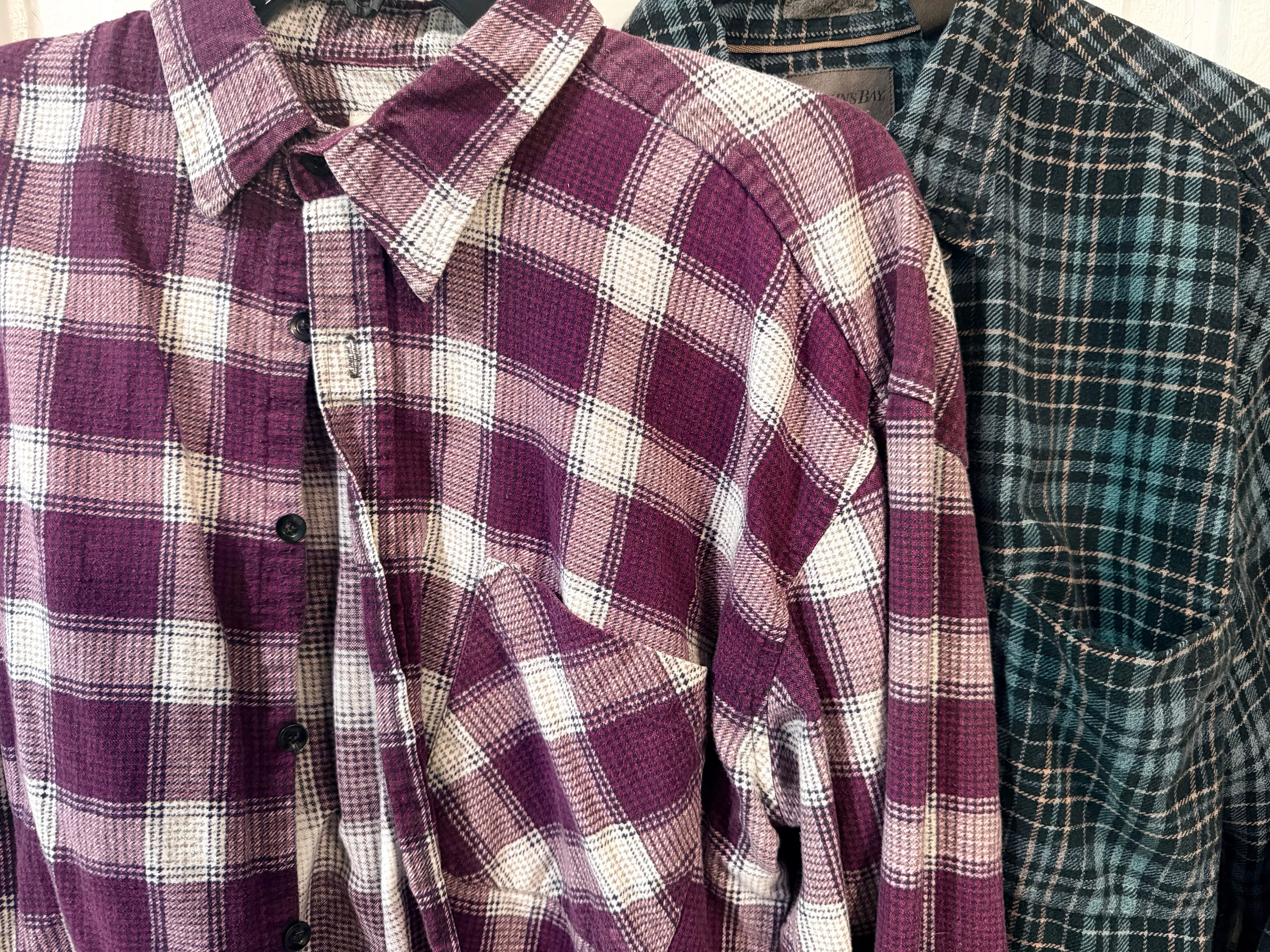
Have you ever wept over clothes? I hadn’t. Not until this moment. In my hands my mom placed two ancient flannels - one red and white, one black and blue, from St. John’s Bay, a JC Penny brand, from decades and decades ago. I shit you not, these were the shirts Papa wore the last time I saw him. I’ve only cried really hard a few times in my life. This was certainly one of them.
I’ve asked myself and my mom if I’m just making it up, if it’s something I just want to be true, if my memory was being blurred, overcome by suppressed emotions. I don’t believe in fate or destiny, or that things typically happen “for a reason”. But my mom remembers taking pictures of him wearing the shirts when I visited, and when my sister arrived an hour after I departed.
My rational mind has tried to fight and defy it, convince myself that it didn’t really happen, but after talking to my sister and my cousins, I’ve given in that these were indeed the shirts he wore that weekend, and accepted that I was meant to have them. They fit me perfectly, even if they’re missing buttons. I feel my Papa and his life when I wear them. I sense him smiling over my shoulder when my wife puts them on. I know he would have adored her, and would have been in love with my son - even if his unruliness is like mine, that once made Papa grumpy.
I wonder, now that he’s gone, if there are ways we keep Papa alive. I know I do with my gardening and my love of quiet contemplation, sitting on the porch and watching the sun rise and fall. Like him, I love good flannel, and will try to fix something that is hopelessly broken so I don’t have to spend money on something new. I sure like a dark joke, and I think I’ve got his wry smile. I see him in my mom when she crosses her arms when she becomes unmovable, or points at me with her index finger as she makes a point. I see all this in the flannels that are hanging in my closet.
Every time I put them on, I find myself saying “Hey, Pop”, feeling like somewhere in them, he’s still there - and therefore so are clues to parts of myself that I’ve never fully understood, because those parts of me are from a man I got to know only at the end.
In memory of the grumpy farmer who left us all those years ago, who grew and made his own pickled jalapenos - the fieriest of their kind known to man.
So, Reader - what’s your worn story about?
Wow this is ... wow. This one definitely made me cry. So heartfelt, so powerful.
Johnny this is so heartfelt I can feel all the mixed emotions and the weight of wanting to help your mother in those times too. Your story strangely echoes my own Grandad (Poppa as he was known to me) born a similar time from a poor cockney family he faked his age to get into the RAF to escape poverty. He died in my final year of my post grad and missed me graduating. He died on St David’s day here in the UK/wales so yellow daffodils always remind me of him - strange how you mention yellow too. I wrote a poem about a military sweetheart ring he gave me that was my Nannas this weekend and was so upset even after 19 years of him having passed - i realised yesterday I was writing the poem on the anniversary of his death. The body holds these things even after such long periods of time. Love to you and your family 🖤